










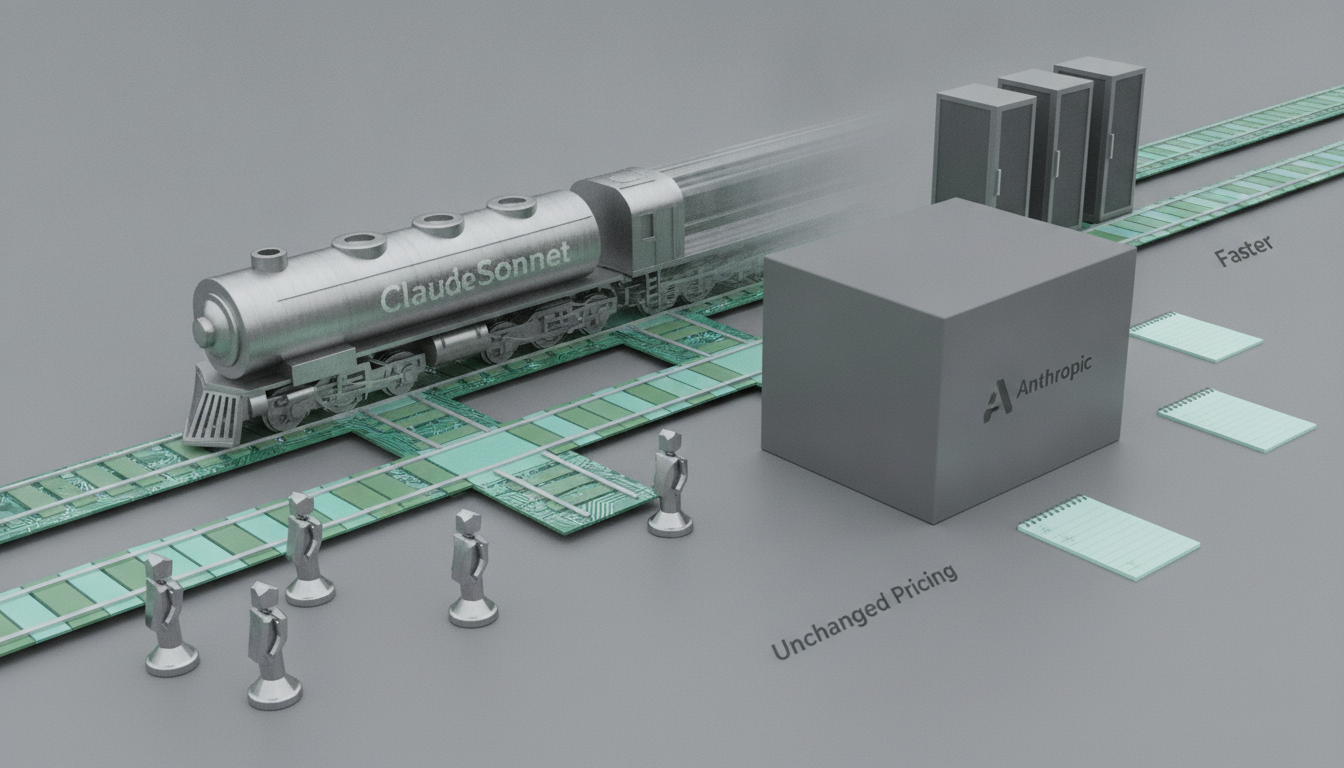
Anthropic just gave production teams a reason to skip an upgrade cycle debate entirely. Claude Sonnet 5.5 lands with the same $2/$10 per million token price as its predecessor. It also runs meaningfully faster on the kind of long, multi-step agent tasks that actually determine production costs. This story follows Same Price Faster Agent.
That combination matters more than any single benchmark score. Control matters more than novelty, and this release is really a story about workflow economics.
Same Price Faster Agent: What Claude Sonnet 5.5 Actually Improves
According to MarkTechPost, Claude Sonnet 5.5 scores 70.6% on Terminal-Bench 4.0. That benchmark measures how well a model handles real command-line and coding tasks. The model also lands within two points of Opus 5.5 on GDPval-AA, a test built around real-world professional tasks.
The more interesting number is speed. Anthropic says Claude Sonnet 5.5 generates output more than 30% faster than Sonnet 5. Because it also uses fewer tokens per task, Anthropic estimates cost per task drops by up to 30%.
For anyone running agents in production, that token efficiency changes the math. A benchmark score tells you what a model can do once. Token efficiency tells you what it costs to do that same task a thousand times a day.
Where You Can Deploy It
Claude Sonnet 5.5 ships today through the Claude API, plus AWS, Google Cloud, and Azure. That multi-cloud availability removes a common blocker for teams locked into a specific vendor stack.
- Direct API access via Anthropic
- AWS Bedrock integration
- Google Cloud Vertex AI support
- Microsoft Azure deployment
A usable workflow needs repeatable results across whichever cloud a team already runs. Anthropic clearly built this release with that reproducibility requirement in mind.
The Bigger Shift: Agents Need Guardrails, Not Just Speed
Claude Sonnet 5.5 arrives during a week when the industry is also racing to make agents safer to deploy, not just faster. NVIDIA launched its Open Agent Safety Platform, and the timing is not a coincidence.
As MarkTechPost reports, the platform pairs two systems. OpenShell is an Apache 2.0 runtime that sandboxes agents under YAML policies. Sentry is a watchdog running on BlueField-4 DPUs that can quarantine a rogue agent in milliseconds.
NVIDIA says more than 100 organizations already work with the platform. That number signals a real shift in how companies think about agent deployment. Speed and capability used to dominate every announcement. Now containment gets equal billing.
Self-Improving Agents Raise the Stakes
Google Cloud AI Research added another piece to this puzzle by open-sourcing RRSI. The framework lets agents rewrite their own prompts, tools, and memory while model weights stay frozen.
Per MarkTechPost, RRSI includes a leakage critic, a noise floor, and a cost rule to stop agents from simply memorizing test answers. With Claude Opus 4.8, Terminal-Bench 2.1 performance rose from 74.2% to 80.2%. All six held-out test splits improved too, which suggests genuine generalization rather than overfitting.
Put RRSI next to NVIDIA’s safety platform and a pattern emerges. Agents are getting better at modifying themselves. The infrastructure to contain them is racing to keep pace.
Voice Agents Learn When to Shut Up
Alibaba’s Qwen team tackled a different but related problem this week: full-duplex conversation. Qwen-Audio-3.1-Realtime is a voice model trained to reason, act, and decide when to actually speak.
According to MarkTechPost, the model cut its false-response rate to background speech from 73% down to 13%. On a τ-Voice benchmark adaptation, task success climbed to 82.0% from 78.4%. Anyone who has argued with a voice assistant interrupting mid-sentence will recognize why this matters.
Alibaba made the model available now as an API through QwenCloud. That puts a genuinely improved voice-agent option into the hands of developers immediately, not months from now.
Policy Catches Up to the Technology
None of this progress happens in a vacuum, and Washington is paying attention. As The Verge reports, Rep. Ro Khanna is pushing for a US-China treaty to limit AI risks. His letters land right as President Trump meets with tech and AI CEOs.
Whether that treaty ever materializes is genuinely uncertain. Still, the request underscores a growing tension. Model releases now ship weekly, safety infrastructure is catching up, and lawmakers worry the pace outstrips any coordinated oversight.
Same Price Faster Agent: What This Means for Builders
If you build agent products, Claude Sonnet 5.5 is worth testing this week, especially for terminal and coding-heavy workflows. The unchanged pricing removes a real barrier to migration.
If you operate agents at scale, pair any model upgrade with a genuine look at containment tools. NVIDIA’s platform and Google’s RRSI framework both suggest the industry expects agents to act more autonomously, not less.
For teams running voice interfaces, Qwen-Audio-3.1-Realtime’s turn-taking improvements deserve a look too. A model that can be interrupted by mid-sentence noise is not production-ready, no matter how good its language understanding is.
Same Price Faster Agent: Takeaways by Creator Type
- Solo developers: Claude Sonnet 5.5’s flat pricing and speed gains make experimentation cheap.
- Enterprise teams: NVIDIA’s sandboxing and Google’s RRSI address real production risk, not just demo polish.
- Voice product builders: Qwen-Audio-3.1-Realtime’s duplex handling closes a genuine usability gap.
Before comparing output quality across these releases, compare the process each one demands. Speed, safety, and self-improvement are converging into a single conversation. The teams that manage all three at once will ship the most reliable agents. A well-configured workstation, like a capable development laptop (paid link), still helps when you’re iterating on these pipelines locally before pushing to cloud deployment.
As an Amazon Associate, TechMogo earns from qualifying purchases.