






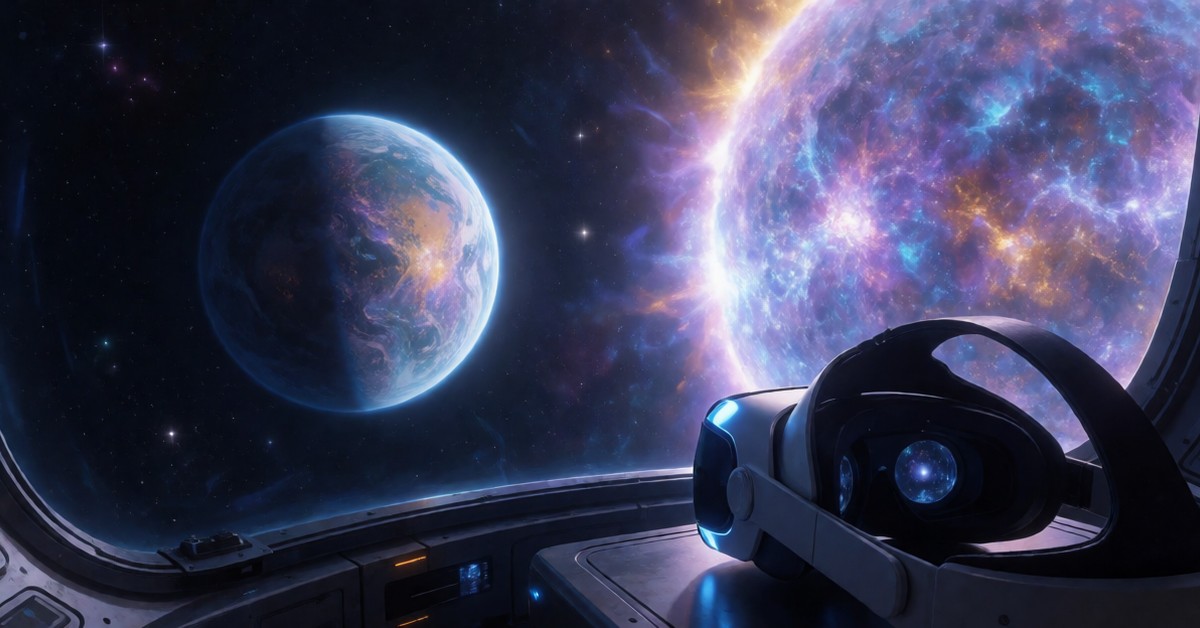
A new virtual reality journey lets people visit distant stars and planetary systems. This walkthrough offers users a chance to view exoplanets and massive viewing posts without ever leaving their current location. The technology allows users to see the vastness of space in ways traditional media cannot fully achieve. This development marks a growing trend in educational technology, which aims to bring complex subjects directly into the user’s environment. People keen on vr space exploration should know that these simulations provide a strong sense of scale and wonder.
Why Does This Matter?
Many users enjoy the immersive nature of these simulations, which lets them stand among celestial bodies thousands of light years away. This journey lets viewers examine various types of stars, including red giants and blue dwarfs, which show stellar lifecycles. The program also features detailed views of exoplanets, which are worlds orbiting stars outside our own solar system. These virtual visits help people understand the diverse conditions that exist throughout the galaxy. Although the experience is engaging, users must remember that this is a picture, not a true scientific model. This specific form of vr space exploration provides a platform for learning about cosmic events in a highly engaging format. Instead of reading about the cosmos, participants walk through the environments of distant planets. This approach makes complex scientific concepts, like planetary orbits, much easier for the general public to grasp. Developers claim the experience successfully translates the intimidating scale of deep space into an easy to handle, navigable digital format. The ability to move freely between a star and a distant viewing post adds a powerful layer of depth to the educational content.
Background
The system uses advanced graphics and spatial audio to simulate the environment of deep space with high fidelity. Users control their movement within the virtual world, allowing them to approach massive gas giants or view nebulae up close. The software relies on data made beforehand and real astronomical images to build these detailed digital landscapes. This process ensures that the visual information presented is based on actual scientific observation. Users wear a headset that tracks their head movements, which translates into the ability to look around the virtual environment freely. This allows for a truly personal and unique vr space exploration.
Viewing exoplanets from a safe distance Observing the mechanics of distant stellar systems Touring virtual astronomical viewing posts Experiencing the sheer scale of the universe
Limits of simulated travel
Although the visual quality of this vr space exploration is impressive, critics note that the simulation lacks true physical accuracy. For example, the experience cannot simulate the actual effects of low gravity or the intense radiation present in deep space. The movement within the virtual world is controlled by the user and does not account for real orbital mechanics or the forces of gravity. This means the experience is primarily a visual tour rather than a scientific simulation of physics. Users must understand that the simulation prioritizes immersion and educational viewing over perfect physical accuracy.
This digital environment presents a powerful tool for education, but it is not a replacement for real scientific study. Developers say the goal of this vr space exploration is to inspire future scientists and help the public connect with astronomy. They claim seeing the beauty of the cosmos in a tangible way prompts people to learn more about space exploration. However, the technology itself remains a simulation, a curated digital version of a complex reality. The limitations of current hardware also mean that the processing power needed for truly realistic physics remains quite high. More powerful computers will eventually make these simulations even more accurate and detailed.
Future Versions of Cosmic Simulation
Looking ahead, researchers suggest that vr space exploration could evolve to include more interactive scientific elements. Future updates might allow users to perform virtual experiments, such as analyzing the atmospheric composition of an exoplanet. Imagine being able to virtually collect data from a virtual telescope, which greatly deepens the educational value of the program. This shift moves the journey from simple viewing to active taking part. The current version focuses heavily on awe and discovery, which is a strong start for the field.
Future versions of this technology could potentially merge real-time data feeds from actual space missions, which would make the virtual environment incredibly dynamic. Instead of static images, users might observe celestial events as they are happening in real life. This level of merging makes vr space exploration an unparalleled educational tool. The ongoing development of the hardware and software suggests the level of detail and interactivity will only grow over time. This continuous growth promises richer journeys for anyone keen on the universe.
In the end, this virtual journey offers a remarkable way for the general public to engage with the wonders of astronomy. It provides a compelling visual narrative of the cosmos, which helps demystify the complex and often intimidating subjects of stellar formation and planetary systems.