










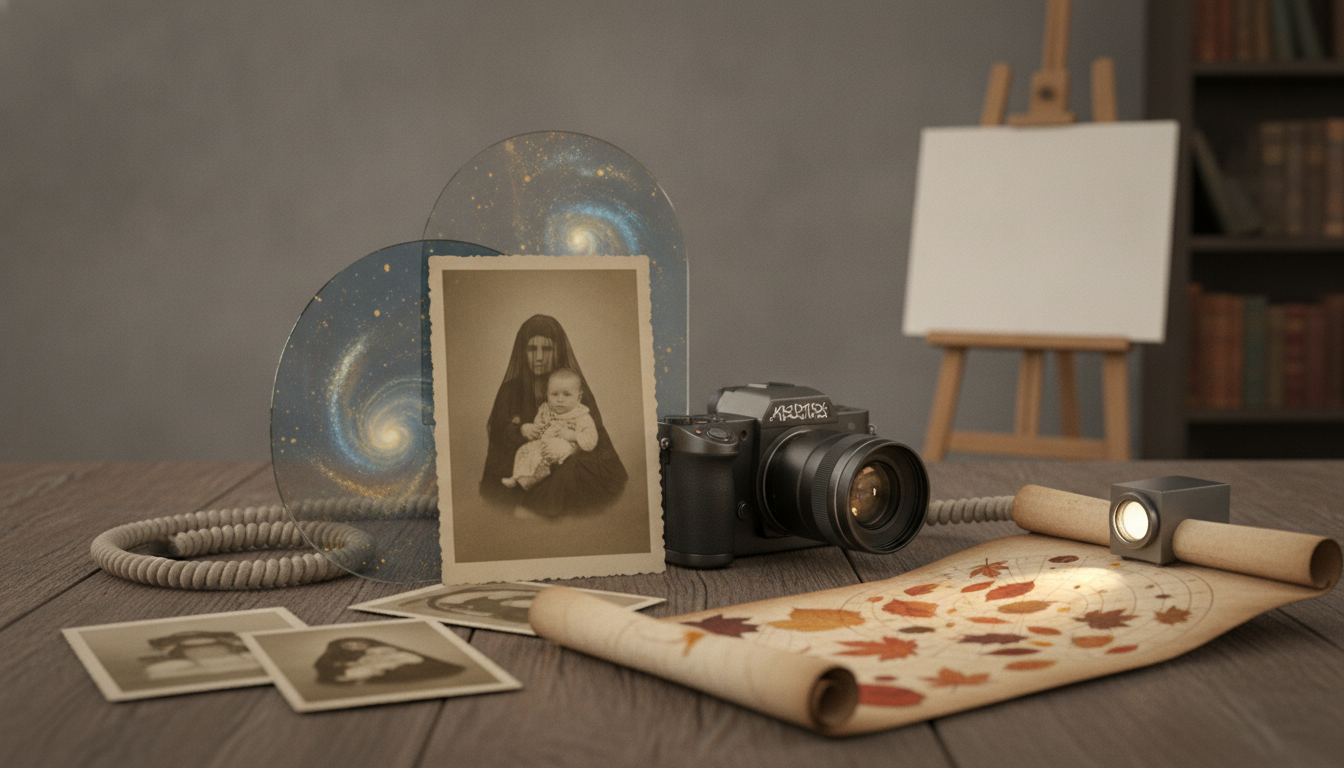
Autumn Light Hidden Mothers: A Season Full of Photography Stories
This week’s photography news spans more than a century. It connects Victorian portrait tricks to the death of our sun. What ties these stories together is craft. Every image, old or new, depends on a photographer solving a problem. This story follows Autumn Light Hidden Mothers.
From hidden mothers in daguerreotypes to folding LED lights launching on Kickstarter, the throughline is clear. Good photography means working around limits, not just owning better gear.
The Hidden Mother Technique Explained
Long exposure times made early portraits brutal for squirming children. Photographers needed a fix, so parents became invisible assistants. As PetaPixel explains in its piece on the historic practice of the hidden mother, the solution was often strange.
A mother might drape herself in a sheet and crouch behind her child. Sometimes she hid behind a cloaked chair instead. The goal was simple: keep the baby still and calm.
Results varied depending on the photographer and the sitter. Some hidden mother portraits look eerie today, with ghostly shrouded figures propping up infants. Others hide the adult so well that modern viewers miss her entirely.
Why This Matters for Modern Photographers
The hidden mother technique shows something timeless about photography. Technical limits force creative solutions, and those solutions become their own genre. Today’s photographers face different limits, but the instinct to adapt remains the same.
Twenty Years of Chasing Fall Color
Autumn photography looks effortless in finished images. It rarely is. A veteran fall photographer recently shared two decades of lessons, as reported by PetaPixel in a piece on photographing fall color.
The biggest lesson is patience. Peak color lasts only a short window each year. Showing up on the right day matters more than owning expensive equipment.
Composition matters just as much as timing, according to the photographer. Scouting locations ahead of the color rush helps enormously. So does returning to familiar spots across multiple seasons to learn how light shifts.
A Confession About Lens Choice
A related PetaPixel piece complicates the usual autumn advice. Photographer Jeremy admits his wide-angle lens stays packed away most of the season. Instead, he reaches for a telephoto lens again and again.
Telephoto lenses compress distant trees into dense walls of color. They isolate single branches against soft backgrounds too. Wide shots can feel cluttered when a forest is this busy with color.
This confession matters because it challenges an assumption. Many beginners think landscape photography always means wide-angle glass. Jeremy’s experience suggests otherwise, especially for foliage season.
An Eerie Glimpse at the Sun’s Future
Not every photography story this week stays earthbound. Astrophotographer Andrew McCarthy released an image showing how our sun will eventually die, according to PetaPixel’s report on an eerie photo of the sun’s death.
McCarthy chose January for this image as part of his 2027 cosmic calendar project. January often gets called the bleakest month of the year. The timing fits the unsettling subject matter well.
The photograph imagines our sun’s transformation into a planetary nebula. That event sits billions of years in the future. Still, the visual hits with unexpected weight, blending science and art into one frame.
Autumn Light Hidden Mothers: New Gear: Maven’s Talon Folding Lights
On the gear side, Maven is stepping outside its usual lane. Known for magnetic lens filters, the company now enters portable lighting. As PetaPixel reports on the new Talon series folding lights, the shift has been seven years in the making.
The Talon lights are pocket-sized and fold flat for easy storage. They launch on Kickstarter next week, aimed at photographers who travel light. Seven years of development suggests Maven wanted this product right before shipping it.
For photographers assembling a travel kit, compact lighting solves a real problem. Hauling full studio lights on a hiking trail is rarely practical. A folding light that fits in a jacket pocket changes that calculus. Pairing one with a reliable portable LED light panel (paid link) gives shooters a lightweight lighting setup for unpredictable outdoor conditions.
Autumn Light Hidden Mothers: What Connects These Stories
Hidden mothers, fall foliage, dying stars, and folding lights seem unrelated at first glance. Each story, though, centers on solving a specific photographic problem.
Victorian photographers hid mothers to manage exposure times. Fall photographers manage fleeting color windows with better planning. Andrew McCarthy uses composition to make abstract science feel immediate and personal.
Maven, meanwhile, solves a logistics problem for traveling photographers. Each case proves that constraints often produce the most memorable images.
Autumn Light Hidden Mothers: Takeaways for Photography Enthusiasts
- Historical techniques like the hidden mother reveal how limits shape creative genres.
- Strong fall photography depends more on timing and scouting than gear alone.
- Telephoto lenses deserve more credit in autumn landscape work.
- Andrew McCarthy’s sun imagery blends astrophotography with genuine emotional weight.
- Maven’s Talon lights target photographers who value portability over bulk.
Photography keeps evolving, yet its core challenge never changes. Photographers must work within real limits to capture something worth remembering. Whether the obstacle is a long exposure or a fleeting season, craft wins out.
As an Amazon Associate, TechMogo earns from qualifying purchases.