










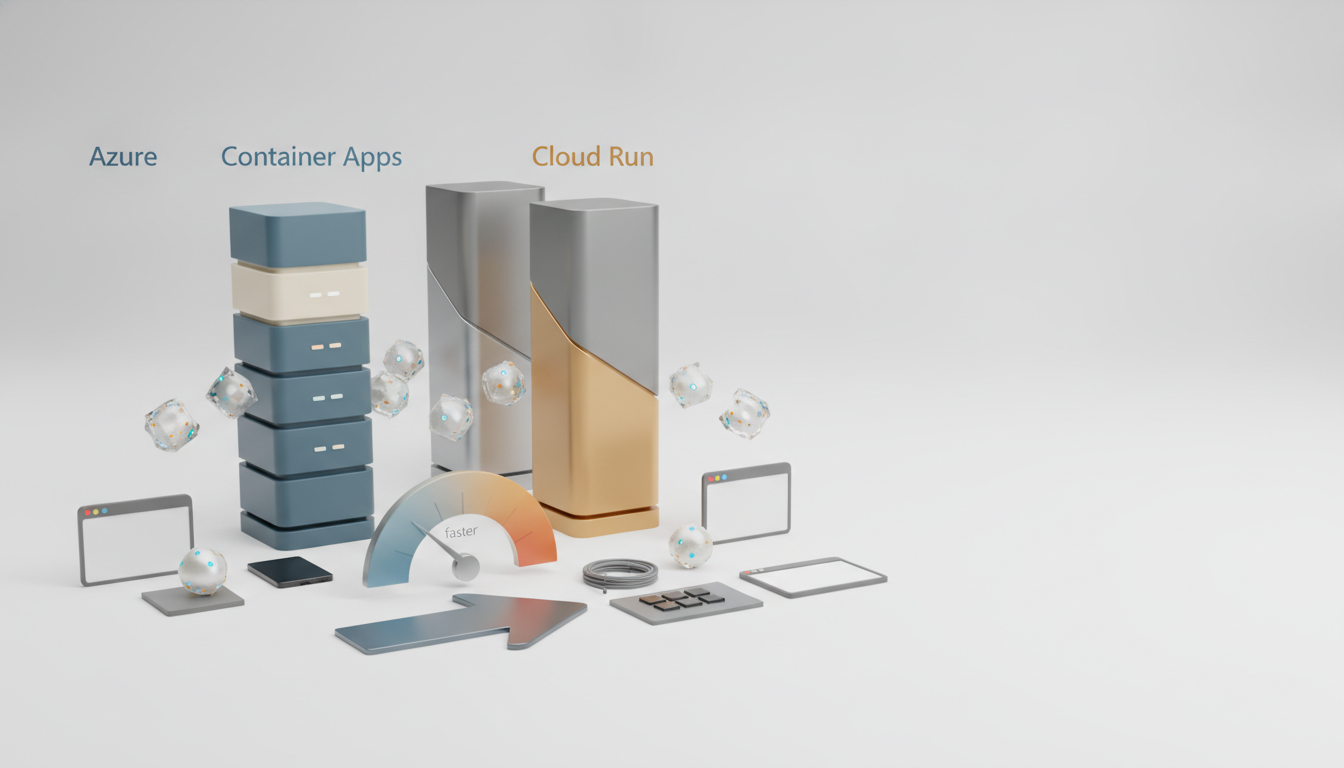
Azure Container Apps Cloud: Azure Container Apps Enters the Serverless Container Debate
Developers keep asking the same question this week. Should they deploy on Azure Container Apps or Google Cloud Run? A new comparison on Dev.to breaks down the tradeoffs clearly. This story follows Azure Container Apps Cloud.
Both platforms let teams run containers without managing servers. However, they solve that problem in different ways.
How Azure Container Apps Stands Apart
Azure Container Apps builds on Kubernetes under the hood. It gives developers access to Dapr integrations and built-in microservice patterns.
That makes it a strong fit for teams already inside the Azure ecosystem. According to the piece, Azure Container Apps also handles complex multi-container workloads well.
Cloud Run, meanwhile, favors simplicity. It spins up a single container per service and scales to zero fast.
Teams choosing Azure Container Apps often want more control over networking and revision management. Teams picking Cloud Run usually want speed and minimal configuration.
Cost and Scaling Considerations
Pricing models differ in subtle ways. Azure Container Apps bills by vCPU and memory consumption over time.
Cloud Run uses similar metering but adds request-based billing for HTTP workloads. Neither option wins outright on cost.
The right pick depends on traffic patterns and existing cloud commitments. Teams with unpredictable spiky traffic may prefer Cloud Run’s faster cold-start recovery.
Why Tool Descriptions Matter for AI Agents
Elsewhere in the developer world, a sharper problem is emerging around AI agents. A post by Conor Bronsdon on Dev.to explains how agents misread tool descriptions.
An agent picks a tool by matching a task description to the tool’s name. Chip Huyen, referenced in the piece, identifies two common failure modes.
First, the agent calls the wrong tool entirely. Second, it calls the right tool but fills in bad parameters.
The fix sounds simple but takes discipline. Write descriptions that make the correct choice obvious at a glance.
Developers should also score tool selection separately from argument generation. That way, errors get caught before they cause damage.
Critically, any tool that deletes or changes data should require explicit confirmation. This mirrors lessons from traditional API design, where destructive actions always need guardrails.
DNS Basics Still Trip Up New Developers
Not every lesson this week involves cutting-edge AI. A guide published in Italian on Dev.to walks through DNS fundamentals.
It covers A records, CNAME records, and MX records in plain language. The author notes that DNS feels simple until someone switches hosting providers.
Suddenly, four or five records all need updates at once. Each record type serves a distinct purpose, and mixing them up breaks email or site access.
This kind of refresher matters more than people assume. Even experienced engineers forget DNS details between infrequent domain migrations.
Layered Architecture Keeps Express.js Apps Maintainable
On the backend side, Devanshu Patil published a deep dive on structuring Express.js applications. The article recommends separating routes, controllers, services, and repositories.
This layered pattern makes large codebases easier to test and extend. Dependency injection and centralized error handling tie the layers together.
It’s a familiar pattern borrowed from enterprise Java and .NET frameworks. Node.js developers are increasingly adopting it as projects scale beyond simple scripts.
Azure Container Apps Cloud: Chunking Strategy Shapes RAG Quality
Finally, a piece from Sham Prakash tackles a quieter but costly mistake. Retrieval-augmented generation systems depend heavily on how documents get chunked.
Chunk size, overlap, and splitting strategy all affect retrieval accuracy. Get it wrong, and the system won’t throw an error.
Instead, it just returns worse answers silently. That makes chunking one of the trickiest parts of building a reliable RAG pipeline.
Azure Container Apps Cloud: Connecting the Threads Across Today’s Developer News
These five stories share a common thread. Developers are refining how systems communicate, whether that’s containers talking to a cloud platform or an AI agent interpreting a tool description.
Choosing between Azure Container Apps and Cloud Run is really about clarity of intent. The same clarity principle applies to tool descriptions, DNS records, and Express.js layers.
Good architecture, in any layer, comes down to reducing ambiguity. If you’re setting up a home lab or test environment to try these platforms yourself, a reliable mini PC for local development (paid link) can make local container testing much smoother.
Azure Container Apps Cloud: Takeaways for Developers This Week
Here’s what stands out from today’s roundup.
- Azure Container Apps suits teams needing Kubernetes-level control and Dapr integration.
- Cloud Run wins on simplicity and fast scale-to-zero behavior.
- AI agents fail when tool descriptions stay vague or overlap in scope.
- DNS record types still confuse developers during hosting migrations.
- Layered Express.js architecture and smart chunking both improve long-term maintainability.
Pick the platform or pattern that matches your actual constraints. That beats chasing whatever trend sounds newest this week.
As an Amazon Associate, TechMogo earns from qualifying purchases.