










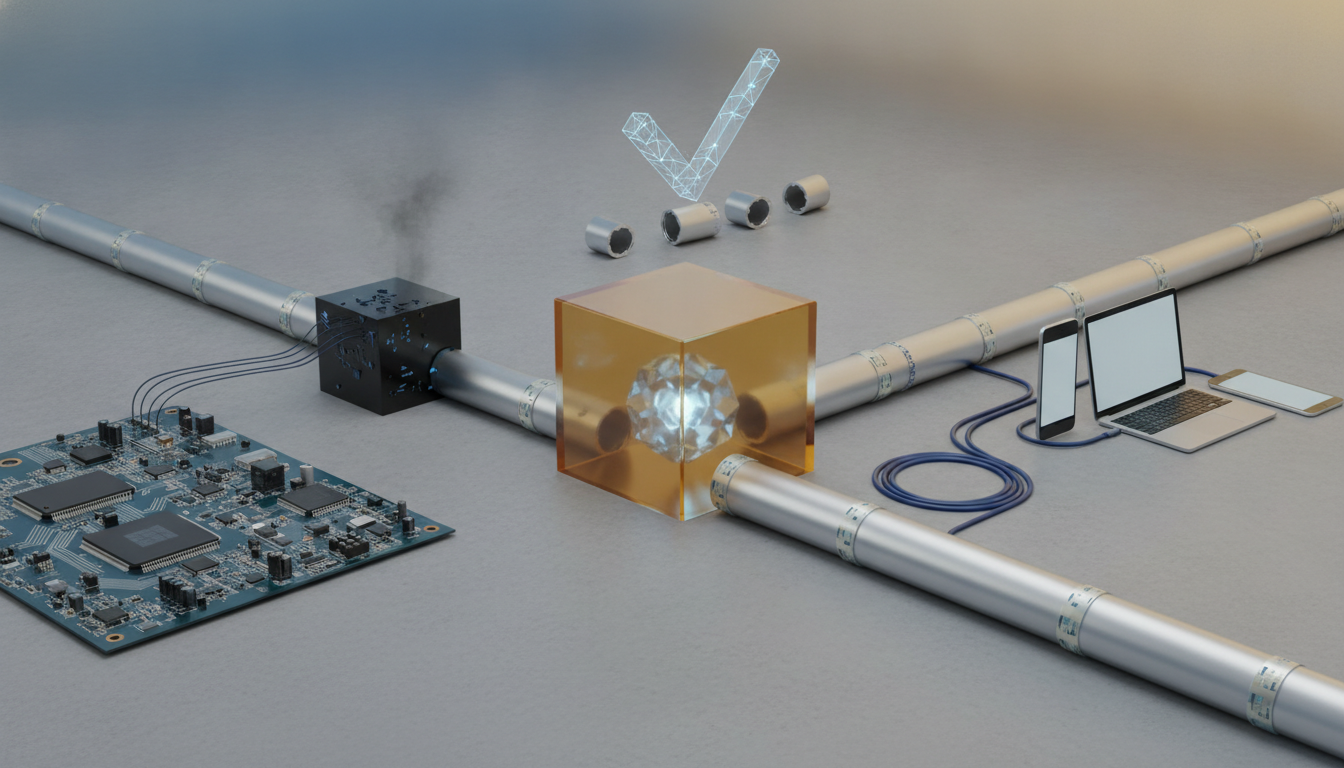
Good design doesn’t announce itself, and neither does a quietly broken AI pipeline. A developer writing for Dev.to recently exposed a flaw that most prompt-engineering setups ignore. The fix centers on an independent AI judge, a second model that checks the first one’s work instead of letting it grade its own homework. This story follows Fixing Self Grading Problem.
Fixing Self Grading Problem: The Quiet Failure of Self-Graded AI
Jamil Fayad, the developer behind the project, identified two failure modes in LLM-generated content. Sometimes a model forgets a required section, like a legal caveat or a citation. Other times, teams ask the same model to score its own output, and that model naturally favors itself.
As Fayad explained in a post on Dev.to, both problems fail silently. Nobody notices until a human reader catches the gap. By then, the flawed content has already shipped.
Why an Independent AI Judge Matters
An independent AI judge changes the incentive structure entirely. Instead of asking a model to mark its own test, a separate model reviews the output against a checklist. This separation removes the bias that creeps in when one system both writes and grades.
The approach echoes a broader shift in how builders think about reliability. Developers no longer trust a single model’s confidence as proof of correctness. They want verification layers, much like unit tests in traditional software engineering.
What makes this interesting is the simplicity of the fix. Fayad didn’t need a complex framework. A second AI judge, paired with a clear compliance checklist, catches errors before any human reviews the result.
A Broader Pattern: Builders Solving Real Gaps
This self-grading fix fits into a wider trend across the developer community this week. Builders are tackling unglamorous but critical gaps in their tools, often without waiting for official solutions.
At Innohacks 4.0, a team called Heisenbugs built a project addressing a different trust problem entirely. Their tool, CryptoTracker, traces stolen crypto from a suspect wallet to the exchange where it gets cashed out, according to team member Vedant Gupta’s account on Dev.to.
Crypto fraud moves quickly. Funds split across wallets, pass through mixers, and cash out before investigators map the trail. The Heisenbugs team wanted visibility into that process, much like Fayad wanted visibility into AI output quality.
Self-Hosting as a Trust Exercise
Elsewhere on Dev.to, Zulqi Awan documented an experiment running full n8n workflows on Vercel’s free plan. Awan paired it with a free Postgres database and a custom domain, as detailed in the original write-up.
n8n expects a server that stays always on. Vercel, meanwhile, runs short-lived functions. That mismatch looked like a dead end at first.
Awan tried it anyway and found it works, within limits. The experiment reflects the same instinct driving the AI judge pipeline: test the assumption rather than accept the default architecture.
Hardware Gets the Same Treatment
Steven Carvajal’s ongoing ESP32 series shows this builder mindset applies to hardware too. In one entry, Carvajal converts a web panel into a Progressive Web App using Vite, so the smart home interface feels like a native app.
In another, Carvajal builds a captive portal for ESP32 devices. This lets users configure Wi-Fi credentials without reprogramming the device, a detail that matters once hardware leaves the workbench and enters someone else’s home.
Both projects solve a version of the same problem as the AI judge pipeline. Each closes a gap between what a system should do and what it actually does by default.
Fixing Self Grading Problem: What This Means for AI Reliability
The common thread across these projects is verification. Builders increasingly refuse to trust a system’s own report of its performance.
For teams building with large language models, the lesson is direct. An independent AI judge costs little to add but catches failures that would otherwise reach customers.
Consider the practical shape of this pattern:
- Separate the model that generates content from the model that grades it
- Build a compliance checklist the judge can apply consistently
- Treat silent failures as the default risk, not the exception
None of this requires exotic infrastructure. A reliable home automation setup, much like the ones Carvajal documents, often starts with something as simple as a well-chosen ESP32 development board (paid link) for prototyping sensors and controllers.
Fixing Self Grading Problem: Takeaways
The AI judge pipeline offers a clear lesson for anyone shipping AI-generated content. Self-grading fails quietly and shows up late.
An independent AI judge catches those gaps before a human ever sees them. Builders across hackathons, self-hosting projects, and hardware series are applying the same instinct elsewhere.
The pattern is simple: don’t trust a system to mark its own homework. Add a second, independent check instead.
As an Amazon Associate, TechMogo earns from qualifying purchases.